Construction Site Security: How to Manage Risk, Responsibility, and Regulation

Discover construction site risks and how the Safer POD® range delivers proactive security and total risk mitigation.

Marise White

Commercial Manager

The Safer summary

Construction sites face significant threats like theft, trespass, vandalism. Awareness of legislation, and the responsibility all workers have to protect a site is paramount.

The best defence for projects against threats prioritises a layered security approach combining perimeter protection with proactive risk mitigation technologies, like those found in the Safer POD® family of PID solutions.

These devices reduce risk, maintain compliance, and protect both people and assets.

The state of the UK construction sector

The UK construction industry contributes £138 billion to the economy each year, employing millions nationwide. Construction sites are busy, open-air centres of productivity that contain high-value assets like plant, machinery, cabling, and fuel.

These assets are highly sought after by criminals, resulting in the construction sector being a frequent target. Building sites are vulnerable due to their open layouts, with weekends or seasonal holidays also often leaving them unoccupied with no oversight.

Allianz Cornhill reports that the construction industry loses more than £800 million annually to theft on site, with further claims that the industry has seen losses of £1 billion.

There are concerns around the growth of organised crime within the industry, with the sophisticated nature of thefts concerning tools and equipment increasing. As a result of this vulnerability, finding the right security solution to protect your project is vital.

Key issues affecting construction site security

Asset theft

The most significant security risk factor affecting the security industry is theft. With high-value assets on site, chief targets for criminals intruding on building sites are plant and machinery.

Excavators, dumpers, bulldozers, and telehandlers are frequently targeted by criminals to be resold overseas. Recent efforts by police to counter this type of theft have resulted in increased spot checks at international ports while a notable case in 2026 halted a gang responsible for the theft of dumper trucks, mini diggers, and other vehicles worth up to £750,000.

The risk of cable theft

Cable theft poses a particular threat to construction sites and infrastructure projects. With the cost of scrap materials like copper ever increasing, thieves profit by selling it on the black market. Costing the UK economy roughly half a billion pounds annually, cable theft carries both a significant monetary loss and a serious public safety risk due to exposed live wiring, shock risk, and power outages.

Intrusion, trespass, and vandalism

Theft is highly damaging, but it is not the only concern for site managers looking to protect their projects. Intrusion and trespass alone can be just as troubling, particularly due to legal liabilities associated with the Occupiers’ Liability Act 1984.

Sites contain any number of hazards. Intrusion incidents that result in injury can leave landowners or contractors at risk of prosecution.

Intrusion further puts a site at risk of vandalism or anti-social behaviour (ASB) with project delays being the most common consequence.

Graffiti, arson, fly-tipping and damage to property can all occur on sites in the wake of an intrusion, creating serious health and safety hazards while also leading to increased costs for repairs or cleaning.

If not properly addressed, this threat can damage the reputation of a developer or contractor who is visibly connected to the deteriorating site.

Occurrences of this behaviour are increasing. A security industry report from 2025 stated that 61% of a sample of industry professionals agreed that vandalism was more of a threat than it had been across the previous 5 years.

Related

Who is responsible for construction site security?

To protect a construction site effectively, a chain of responsibility must be established. The ultimate responsibility is held by the developer. Once in a construction phase, control sits with the principal contractor, who manages the day-to-day safety and security under their obligations.

These include the Construction Design and Management (CDM) regulations 2015, which direct all site security measures and ensure the health and safety of both the public and any assets on site.

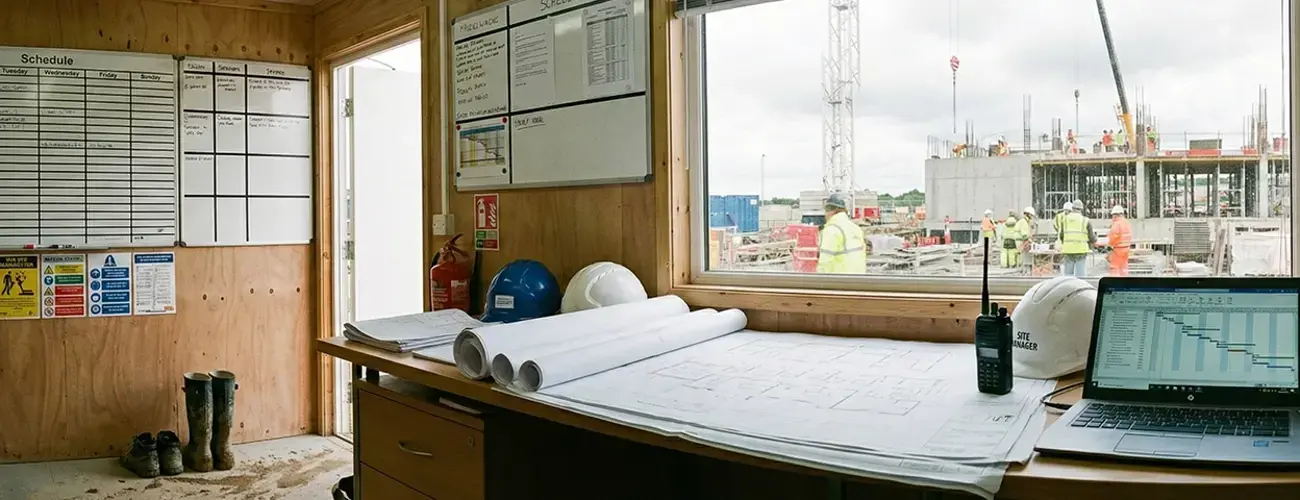
The principal contractor develops the site security policy, conducts formal risk assessments, and controls the security budget. On projects with more than one contractor, the principal contractor is appointed by the developer.

Site or project managers take responsibility ‘on the ground’ for maintaining standards set by the principal contractor. This includes ensuring access control systems are in operation and preventing trespass and theft.

Liaising with security providers, the site manager takes an active role in ensuring security, health and safety checks are carried out consistently and effectively to minimise risks.

All workers on a construction site carry responsibility. No matter if they are a subcontractor or individual worker, all must comply with the policies set by the principal contractor.

Whether it is enforcing the correct use of PPE with a colleague, or reporting potential hazards, fostering a culture of safety and security relies on standards being maintained by all.

Construction site security solutions

Traditional approaches

Proactive construction site security is multi-layered, beginning with the physical reinforcement of the project’s perimeter. Secure perimeter fencing, made from a robust material like steel, is a common deployment to prevent any intrusion or trespass.

Fencing also provides a visible surface on which signage can be applied. Construction site signage is required to cover four groups: prohibition, mandatory, warning, and emergency signs.

Under the Health and Safety (Safety Signs and Signals) Regulations 1996, these are a legal requirement in the UK. Signage is also required to conform to international BS EN ISO 7010 guidelines for graphical safety symbols.

Maintaining a tidy site plays an important role in deterring intrusion and theft attempts. Visible valuables like power tools should be locked away in a heavy-duty container and kept out of sight. Where possible, access equipment like ladders should be removed and open trenches covered.

Considering the broken window theory, visible signs of disorder and neglect on an unkempt site covered in graffiti or litter could serve to encourage further anti-social behaviour. A clear, clean site removes the risk.

Beyond the perimeter, sites are commonly protected by a security officer. These ‘manned guards’ are commonly combined with fencing and perimeter protection to create an enhanced visible deterrent that controls access to the project. Patrols across the site, conducted on a regular basis, are effective as guards can spot suspicious activity and hazards.

Modern technologies

Modern technologies offer enhanced detection capabilities in comparison to traditional options. Fixed CCTV, reliant on the strategic placement of devices across high-risk areas on a site, is a widely-used solution across construction sites.

Modern CCTV camera systems offer enhanced configurations, with AI-powered analytics - to eliminate false alarms and pan, tilt and zoom options to reduce blind spots - in high demand as criminals adapt to the inherent limitations of the technology. Clear signage is a legal requirement when utilising CCTV on your project, and set-ups must be compliant with UK data privacy laws.

Related

While an effective detection method for site crime that has already taken place, CCTV is limited by the fact that it is inherently reactive. Where deterrence is a priority, perimeter intrusion detection devices (PIDs) are considered a reliable solution.

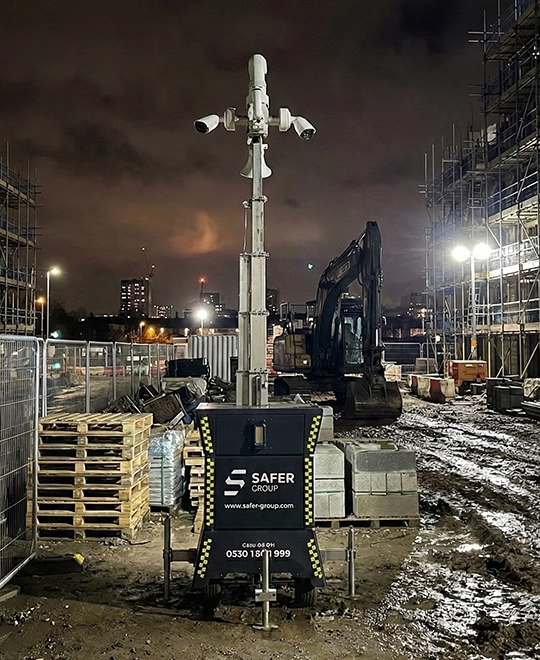
Often referred to as ‘security drones’ or ‘CCTV towers’, these solutions are popular within the site security space as they can protect against a wide range of threats, including intrusion, theft, anti-social behaviour, fire and flooding.

Intended for deployment alongside or in place of traditional security solutions, PID devices provide reliable, visible deterrence and detection. Often equipped with a combination of both photo on demand (PhOD) camera equipment and bespoke CCTV masts, these solutions are typically deployed either on the perimeter or in the interior of a premises.

PID devices create an early warning system, with 24/7 live monitoring by control room operatives. Incident images are sent to the site keyholder, and a mobile response team can be deployed if required.

On the scene, sirens and flashing lights are triggered when a threat is detected. This is often enough to deter a potential malicious event before it escalates.

The Safer POD® family

Safer Group both design and manufacture the Safer POD® range of PID devices. Each solution can offer a configuration to best fit specific site requirements.

The Safer POD® range has customisation options that go further than security, creating solutions that offer full risk mitigation.

Fire threats can be visually verified through thermal imaging, while smoke, heat and CO2 sensors can be used to identify emerging risks. Flood risks are contained by pressure monitoring, leak detection, automatic shut-off valves, and real-time alerts.

Configurable to every device in the Safer POD® family, these customisation options create full risk mitigation in a single solution, operated by a single provider.

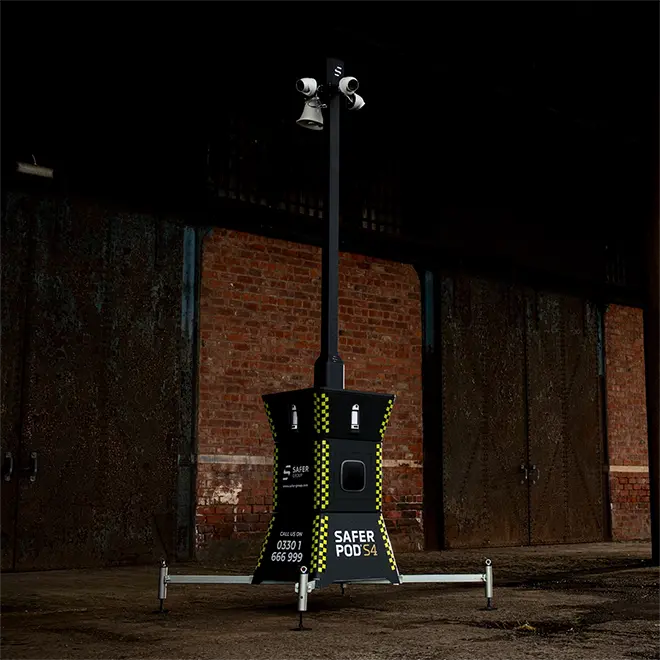
A system best suited to construction sector challenges is the Safer POD® S4/X4. Ideal for medium to large scale sites, this solution is enhanced by an active thermal detection camera configuration.

Active thermal detection can alert to potential intrusion, theft, and fire risks no matter the environmental conditions. Furthermore, the X4 variant features a dynamic luminance alert system signals active watch and enhances the visual deterrent effect of the solution.

Safer POD® S4/X4

Award-winning perimeter protection with active thermal detection, ideal for medium-to-large projects.

  • Bi-spectrum active thermal detection up to 100m
  • 50m infra-red night vision
  • Methanol fuel for zero emissions aside from heat and water
  • Pulsing illumination signalling active watch and alerts (X4 only).

All security solutions offered by Safer Group are integrated into an in-house control room and reviewed 24/7 by monitoring operatives. This process reduces risk, provides an immediate alert response with full audit traceability, and provides peace of mind.

How should you protect your project?

With escalating risks like theft, trespass, and vandalism to contend with, firms are increasingly reliant on construction site security.

Effective solutions take the value of assets, the diversity of site conditions, and regulatory responsibilities into account while prioritising the protection of people and ensuring projects remain on schedule.

Implementing an effective site security strategy is reliant on collective input from all stakeholders, from the day-to-day workers on site to the developer leading the project.

The recommended approach to protect a construction site begins with the adoption of a layered strategy, prioritising perimeter protection to prevent unauthorised access and a clear, compliant process to follow.

While traditional methods like manned guarding can provide immediate value in response to threats once identified, modern surveillance technology like the perimeter intrusion detection device can present a more efficient solution for proactively detecting and deterring threats.

Solutions like the perimeter intrusion detection devices found in the Safer POD® range can be deployed rapidly. Monitored 24/7, these solutions alert in real time to halt incidents and provide a visible deterrent to prevent threats before they escalate.

Need site protection?

Let's secure what matters most

Book a site visit

Step 1
Step 2
Step 3
Step 4
Step 5

What sector are you in?