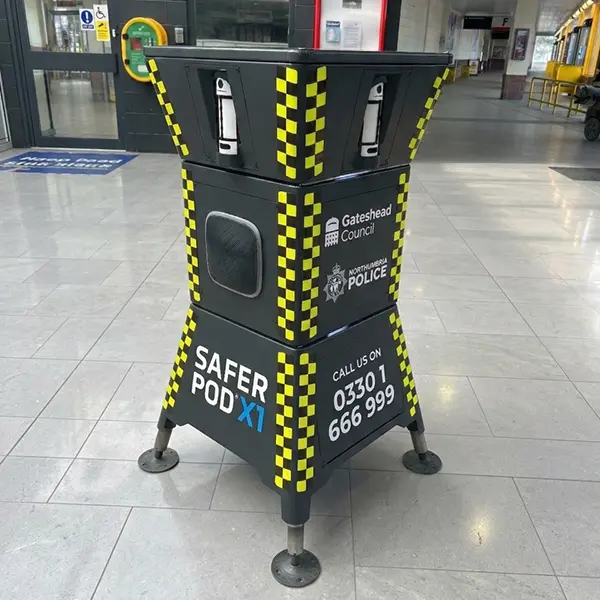
Across our deployments within public spaces, we have consistently observed that communities rarely become crime hotspots overnight. Instead, they follow a familiar pattern of risk escalation.
Environmental Friction
Low-level ASB, loitering, graffiti, and fly-tipping begin to emerge. Individually, these incidents may not require an immediate police response but still demand attention.
Confidence Erosion
Residents and local businesses become aware of the heightened environmental friction. Perceived safety declines among those who live and work in the space.
Public Disengagement
Law-abiding members of the public, like families, shoppers, and commuters, may begin avoiding the location due to a perceived reputation. This removes any self-regulation within the space and may affect the financial viability of businesses.
Criminality
A downturn in legitimate footfall ultimately creates opportunities for higher-level offending, bringing with it greater public safety concerns.
Safer POD® solutions are implemented across every stage as both proactive and reactive crime prevention measures. During phases 1 and 2, our autonomous POD® solutions can proactively disrupt emerging criminality, preserve public funds caused by low-level crime, and maintain the security of an area. If protecting an established crime hotspot in phases 3 and 4, rapid deployment can establish immediate security within the area, signalling active watch to potential offenders and breaking the cycle of disorder.